3. Introduction of computation complexity
19th, Sept.
- Reference: computers and intractability
- Reference: UCI lecture
3.1. Compare pros and cons of different algorithm
- Experiment? Need to run in the same environment
- Complexity analysis. Independent from environment
- Scale examples:
- binary tree search (depth = n):
- Traveling Salesman Problem (TSP, n cities):
- binary tree search (depth = n):
3.2. Classification of problems
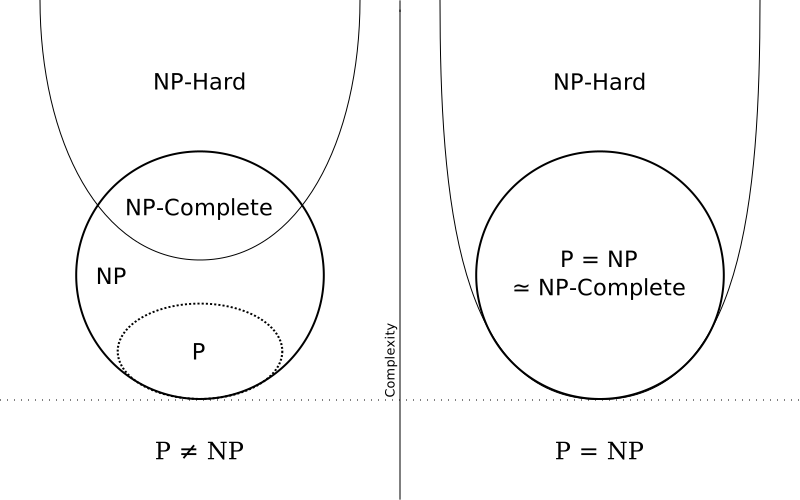
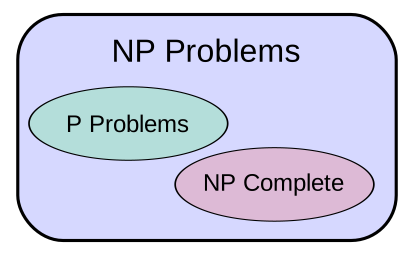
- P: Problems that can be solved in polynomial time
- NP: This stands for “nondeterministic polynomial time” where nondeterministic is just a fancy way of talking about guessing a solution
- Does not stand for “non-polynomial”!!!
- A problem is in NP if you can quickly (in polynomial time) test whether a solution is correct (without worrying about how hard it might be to find the solution)
- Reduction (polynomial reduction)
- Eg:
PA: sort scores of the whole class;PB: find the highest score in the class PAis polynomial reducible toPBif an algorithm for solvingPBefficiently (if it existed) could also be used as a subroutine to solvePAefficientlyPBis at least as hard asPA
- Eg:
- NP-completeness: judgment problem
, for all other decision problems
, we have
, then
is NP-completeness
- NP completeness is the most hard problem of all NP problems
- Any given solution to an NP-complete problem can be verified in polynomial time
- But there is no known efficient way to locate a solution in the first place
- What to do when facing NP-complete problem?
- NP-complete set
- NP hard