2. Graph search strategy
14th, Sept.
2.1. State space
- From initial state to objective through medium states
- Assumptions:
- The agent has perfect knowledge of the state space (full observability)
- The agent has a set of actions that have known deterministic effects
- Some states are goal staes, which the agent wants to reach
- A solution is a sequence of actions that will get the agent from its current state to a goal state
- Eg: Sentence parsing
- Input string (initial state)
- Substitute according to regulations
- Output if the string is a sentence (objective)
- Eg: Judge if a snippet is in C language
- Eg: Traveling salesman problem (TSP)
- Can be formalized with string
- Eg: Missionary and wild man
2.2. Tricolor Algorithms
- Reference
- And abstract description of graph traversal
- Graph nodes are assigned one of three colors that can change over time
- White undiscovered
- Black reachable and done
- Gray discovered but not done
2.3. Basic Graph Search Algorithm
Breadth first search (BFS)
- Illustration

- Pseudocode
// let s be the source node
frontier = new Queue()
mark root visited (set root.distance = 0)
frontier.push(root)
while frontier not empty {
    Vertex v = frontier.pop()
    for each successor v' of v {
    if v' unvisited {
        frontier.push(v')
        mark v' visited (v'.distance = v.distance + 1)
    }
    }
}
Depth first search (DFS)
- Illustration

- Pseudocode
DFS(Vertex v) {
    mark v visited
    set color of v to gray
    for each successor v' of v {
    if v' not yet visited {
        DFS(v')
    }
    }
    set color of v to black
}
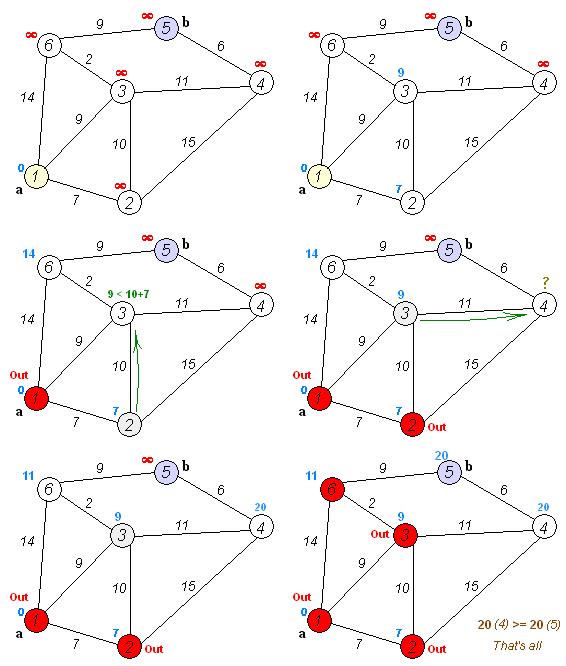
Hill-climbing method
- Manhattan distance or L^1 norm
- Search for the node who has the smallest L^1 norm (greedy algorithm) to the target.
- Can be applied to any problem where the current state allows for an accurate evaluation function.
- Application on TSP.
2.4. Heuristic Search
- For every node, define a cost function:
- Heuristic function
, which takes a node n and returns a non-negative real number that is an estimate of the path cost from node n to a goal node.
- Basic search algorithm can be attributed to heuristic search:
- BFS:
- DFS:
- BFS:
 algorithm

- A* is implemented by treating the frontier as a priority queue ordered by
.
- Proposition (Admissibility of A) A always finds an optimal path, if one exists, and the first path found to a goal is optimal, if
- the branching factor is finite (each node has only a finite number of neighbors),
- arc costs are greater than some
, and
2.5. Influencial Factors of Speed of A*
- Extended node number
- Computation cost of h(x)